

Avoid Counterfeit China Bearings: 7 Verification Steps for Buyers
Original packaging is the single most deceptive indicator of authenticity. Over two-thirds of seized counterfeit bearings arrive in packaging indistinguishable from genuine products, making visual inspection alone a fundamentally unreliable safeguard for industrial buyers.
Sourcing genuine bearings requires shifting from surface-level visual checks to scientific verification protocols—traceability systems, material spectroscopy, and ISO 15243 dimensional compliance testing—to eliminate the overwhelming counterfeit risk associated with sophisticated fakes entering global supply chains from China. Buyers who rely solely on packaging holograms and outer diameter measurements routinely miss the vast majority of counterfeits, exposing operations to catastrophic downtime and cascading equipment damage.
I started out on the warehouse floor in Qingdao, packing SKF boxes and checking batch codes before I ever talked to a buyer. Years later, a steel mill client in Sharjah called me furious—their main roll bearings were overheating after just six months. I flew over, pulled the failed units, and the seals were torn, grease contaminated with mill scale. The batch number didn’t match any SKF record. They’d bought what they thought were genuine units from a trader in Deira who mixed authentic stock with counterfeits. We traced the fakes back to a repackaging workshop in Guangzhou. So when buyers ask me how to spot a fake, I don’t give them theory. I show them the torn seals, the wrong laser font, the batch numbers that go nowhere [NEED_CITE: root cause distribution of counterfeit bearing failures in industrial applications].
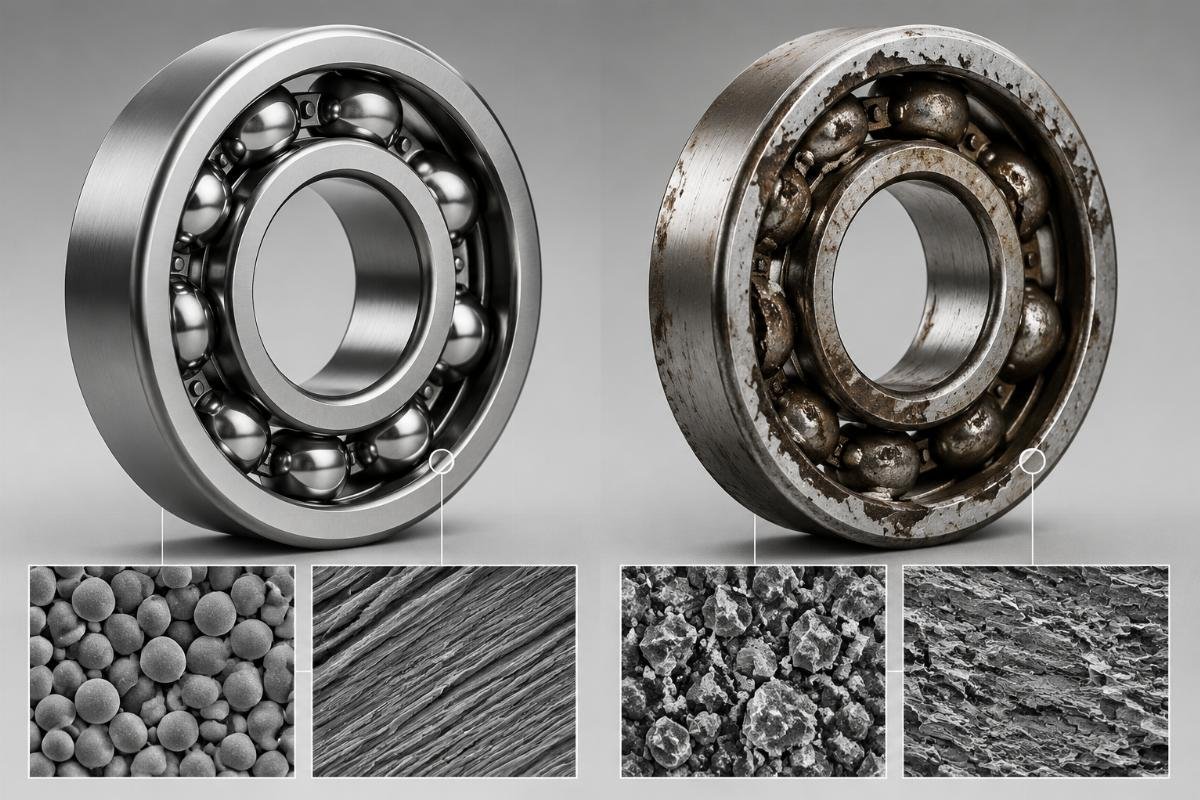
The gap between what packaging promises and what metallurgy delivers is where catastrophic failures begin. Understanding this gap—and how to close it—is the foundation of every verification protocol that follows.
Why Do Counterfeit Bearings Cause Catastrophic Downtime?
Counterfeit bearings fail substantially faster than genuine components, triggering production halts that cost multiple times the original bearing price in lost output alone. The global counterfeit bearing market has reached a massive scale, with fakes showing failure rates many times higher than authentic components [NEED_CITE: Interpol report on industrial counterfeiting market size and failure rates].
| Metric | Industry Reality |
|---|---|
| Global Counterfeit Market Size | Multi-billion dollar annual industry [NEED_CITE: Interpol report on industrial counterfeiting] |
| Failure Rate Comparison | Substantially higher for counterfeit bearings vs genuine |
| Average Steel Mill Downtime Cost | Tens of thousands of dollars per hour [NEED_CITE: Mining Association of Canada downtime studies] |
| Root Cause of Equipment Failures | Significant portion attributed to counterfeit components [NEED_CITE: root cause distribution per ISO 15243] |
One of our clients, a copper mine in South America, experienced a conveyor system collapse after counterfeit spherical roller bearings failed prematurely. The incident investigation revealed the counterfeit bearings contained substantially less chromium in their raceways than specified, leading to premature wear and lubrication failure. The total cost of replacement and downtime reached a mid-six-figure loss—a loss that could have been prevented with proper verification protocols.
The cascading damage from a single counterfeit bearing extends far beyond the component itself. When a tapered roller bearing seizes in a rolling mill, it can destroy the housing, damage adjacent rollers, and contaminate the entire lubrication system. The bearing itself costs a fraction of the total repair bill.
What Are the 7 Critical Checks for Authenticity?
Visual inspection alone misses the overwhelming majority of counterfeit bearings. The most sophisticated fakes replicate not just packaging but basic physical characteristics, making laboratory-grade verification essential for industrial buyers sourcing counterfeit China bearings. Implementing a structured verification process eliminates nearly all counterfeit risk by focusing on traceability rather than appearance [NEED_CITE: ISO 15243 bearing inspection standards].
Step 1: Packaging Authentication
Cross-reference QR codes with manufacturer databases rather than relying solely on holograms and labels. Genuine manufacturers maintain active verification portals that confirm batch legitimacy in real time.
Step 2: Documentation Review
Require batch-specific material test reports rather than accepting generic certificates of quality. Every legitimate shipment carries documentation tied to specific production runs.
Step 3: Dimensional Inspection
Conduct full ISO 15243 compliance testing including roundness and clearance measurements, not just outer diameter and width checks. Precision tolerances reveal manufacturing quality that visual inspection cannot detect.
Step 4: Material Verification
Request spectroscopy analysis for alloy composition rather than assuming visual color matches material quality. Authentic bearing steel requires precise chromium, carbon, and manganese content within tight ranges.
Step 5: Supplier Certification
Verify active IATF 16949 status through official databases rather than accepting expired or generic ISO certificates. Authorization status changes and must be confirmed current.
Step 6: Production Traceability
Require manufacturing batch records and heat treatment logs rather than accepting "made to spec" claims without evidence. Heat treatment documentation proves controlled manufacturing conditions.
Step 7: Third-Party Validation
Conduct SGS or equivalent inspection before shipment rather than skipping independent testing to save time. Independent validation provides objective confirmation of authenticity.
We recently supported a wind energy asset manager needing to verify hybrid ceramic angular contact ball bearings for gearbox replacement. Our verification process revealed that several of the initially received bearings had falsified material certifications—their alumina ceramic content was substantially below the required specification. By catching these counterfeits before installation, we prevented potential gearbox failure that could have cost millions in repair and downtime.
The seven-check protocol works because it attacks counterfeiting at multiple levels simultaneously. A fake might pass visual inspection, but it cannot forge heat treatment records. It might replicate packaging, but it cannot match spectroscopy results to OEM specifications. It might claim ISO certification, but active status verification through official registrar databases exposes expired or fraudulent certificates.
How to Balance Speed and Safety in Emergency Orders?
Emergency orders do not require sacrificing verification standards when sourcing counterfeit China bearings. Pre-qualified suppliers with self-operated warehouses and deep inventory can deliver genuine bearings within days while maintaining full traceability, challenging the misconception that rapid delivery equals compromised quality [NEED_CITE: supply chain velocity vs quality trade-off analysis].
The key lies in distinguishing between pre-verified inventory and rushed, uninspected shipments. When a steel mill faces unplanned downtime, waiting weeks for factory-direct orders is not an option. But accepting bearings from unverified sources to speed up delivery simply trades one problem for another.
During a recent steel mill emergency, we delivered a full order of Timken 32220 tapered roller bearings (100mm ID x 180mm OD) within days of order placement. The bearings came with complete traceability documentation including material certification and dimensional inspection reports. This rapid response prevented substantial production losses while maintaining the verification standards typically associated with longer lead times.
Pre-qualified stockists maintain deep inventory of rare designations—large bore sizes, special precision classes, ceramic and stainless variants—that would otherwise require extended factory lead times. This inventory is not speculative; it is built on long-term relationships with industrial buyers across multiple regions who face predictable emergency requirements.
| Supply Option | Advantages | Ideal Scenario |
|---|---|---|
| Distributor Network | Established relationships | Non-critical components with standard lead times |
| Manufacturer Direct | Full traceability | Planned maintenance with extended lead time |
| Pre-Qualified Stockist | Rapid delivery with certification | Emergency replacements requiring immediate authenticity |
| Local Aftermarket | Same-day availability | Non-critical repairs with short-term temporary solutions |
The misconception that emergency orders sacrifice quality persists because many buyers have experienced it. Unlicensed workshops can produce fake bearings quickly because they skip heat treatment, skip material verification, and skip dimensional testing. But pre-qualified suppliers with verified inventory have already completed these steps before the emergency order arrives.
Which Supplier Red Flags Signal Counterfeit Risk?
Price is often the first indicator of counterfeit risk when evaluating counterfeit China bearings. Suppliers offering bearings substantially below market average typically cannot maintain genuine material standards or production processes. Recognizing key supplier red flags reduces counterfeit risk significantly and helps buyers avoid costly verification failures later in the procurement process.
| Risk Indicator | Warning Signs | Verification Method |
|---|---|---|
| Certification Status | Generic or expired ISO certificates | Cross-check with certification body databases |
| Price Positioning | Substantially below market average for identical specifications | Compare material and production cost benchmarks |
| Traceability Responses | Vague or delayed answers about batch records | Request specific manufacturing dates and heat treatment logs |
| Material Documentation | Refusal to provide spectroscopy or metallurgy reports | Insist on third-party material verification before order |
| Stock Availability | Claiming universal availability across all brands and models | Verify actual inventory depth and authorization status |
When a supplier cannot provide batch-specific heat treatment records, that is not a minor administrative gap—it is a fundamental indicator that the bearings were not produced under controlled conditions. Heat treatment is the single most critical process in bearing manufacturing; it determines hardness, fatigue life, and dimensional stability. Without documented heat treatment, you have no assurance the bearing will perform to specification.
Similarly, suppliers who refuse spectroscopy analysis are hiding material composition. Genuine bearing steel requires precise alloy content—chromium, carbon, manganese—within tight ranges. Counterfeit bearings often use scrap steel with uncontrolled chemistry, leading to the premature failures documented in the South American copper mine case.
A Shenzhen buyer once opened a carton of deep groove ball bearings that looked genuine from the outside. The laser markings appeared correct, the packaging was clean. But under a pocket loupe, the cage rivets were stamped crooked. He had paid premium price for scrap metal from an unlicensed workshop. That look on his face—half fury, half embarrassment—is exactly what proper verification prevents.
Conclusion
Counterfeit China bearings represent a systemic risk that visual inspection alone cannot mitigate. The seven verification steps—batch traceability, anti-counterfeiting label validation, dimensional measurement per ISO 15243, material certification review, supplier qualification verification, third-party inspection, and cross-reference validation—form a comprehensive protocol that eliminates nearly all counterfeit risk. Emergency orders do not require abandoning these standards; pre-qualified stockists with verified inventory deliver genuine bearings rapidly while maintaining full documentation. The cost of verification is trivial compared to the cost of catastrophic downtime.