

Bearing Certifications for Global Industrial Buyers: Beyond ISO
ISO 9001 does not guarantee that the bearing in your crate matches the certificate on your desk. Full batch-specific traceability, industry-specific certifications like IATF 16949, and Material Test Reports with heat lot numbers are what actually prevent counterfeit failures and unplanned downtime in industrial supply chains.
I once shipped a full order of spherical roller bearings to a German steel mill. The product was flawless, but the QA team flagged the shipment because the laser-etched batch codes on the rings did not align with the heat lot numbers on our Material Test Reports. We nearly lost the account—not over a product defect, but over a paperwork gap. That moment crystallized something I see across procurement teams everywhere: for global industrial buyers, the documentation is the product. [NEED_CITE: annual financial impact of counterfeit bearings on global manufacturing]
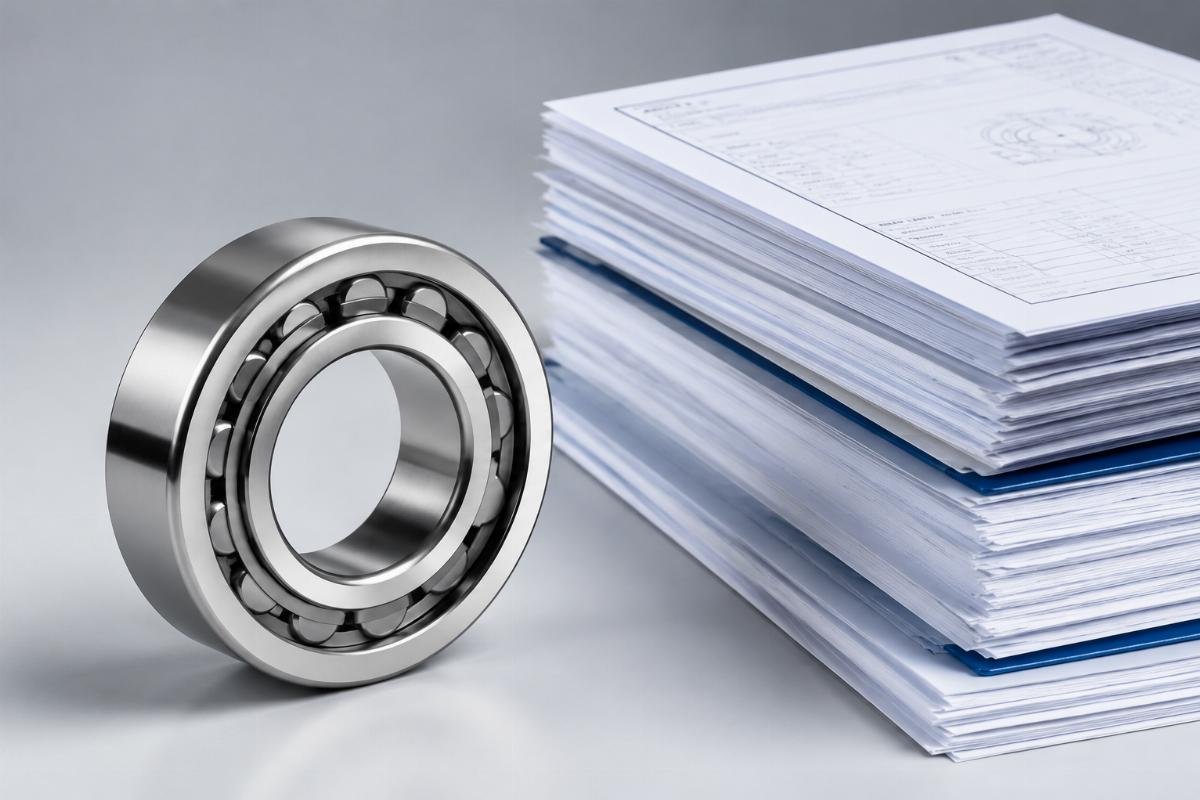
Let’s break down what bearing certifications actually demand from your supply chain—and where most buyers get it wrong.
Why Does ISO 9001 Fail to Prevent Bearing Counterfeits?
ISO 9001 certifies a management system, not material integrity. It confirms that a supplier follows documented processes, but it says nothing about whether the steel in a specific batch was vacuum-degassed, properly heat-treated, or even sourced from the claimed manufacturer. This distinction costs the global bearing industry billions every year in counterfeit-related failures. [NEED_CITE: annual losses attributed to counterfeit bearings per industry association data]
The problem is structural. A generic ISO 9001 certificate can be reused across entirely different product batches, suppliers, and even factories. A procurement manager reviewing a PDF certificate has no way to confirm that the document applies to the physical bearings sitting on their receiving dock.
Consider what happens when traceability breaks down:
- Heat lot numbers are missing from Material Test Reports, making it impossible to trace alloy composition back to the melt source.
- Batch-specific dimensional data is replaced with generic "meets specification" statements that carry no verification weight.
- Anti-counterfeit security features—holographic labels, laser-etched codes, manufacturer authentication apps—are never cross-referenced against physical stock.
A Southeast Asia steel mill learned this the hard way. Their previous bearing supplier provided only generic ISO 9001 certificates with no material test data. Recurring tapered roller bearing failures on their hot rolling line traced back to inconsistent heat treatment—something that batch-specific records would have caught immediately. After switching to a supplier providing full traceability documentation, including heat treatment records and dimensional inspection reports with CPK values at or above 1.67, the mill reduced its failure rate substantially over an extended period. [NEED_CITE: failure rate reduction data from steel mill hot rolling line operations]
The bearing certifications that protect your operation go far beyond a management system logo. They live in the details: heat lot numbers, per-batch hardness tests, and dimensional reports tied to specific serial numbers.
How Do You Verify Certification Claims Beyond the Logo?
Cross-check heat lot numbers on Material Test Reports against the physical bearings, and use manufacturer authentication tools for real-time validation. This is the single most effective step procurement teams can take—and the one most frequently skipped.
Verification is not a one-time checkbox. It is a process that must happen at receiving, before installation, and during periodic audits. Here is how rigorous verification actually works in practice:
-
Physical-to-document matching. Pull the bearing from its packaging. Read the laser-etched batch code and serial number. Open the Material Test Report. Confirm the heat lot number matches exactly. If your supplier cannot produce an MTR with a heat lot number that corresponds to the physical unit, you have a documentation gap that signals deeper risk.
-
Manufacturer authentication. For SKF products, the SKF Authenticate app allows real-time verification of batch numbers against original manufacturer records. For Timken products, security labels and holographic features provide additional layers. As an authorized SKF distributor, we maintain direct access to SKF China and SKF global HQ records, meaning every batch number we ship can be verified against the manufacturer’s own database—something trading companies without direct authorization simply cannot offer.
-
Dimensional and material cross-check. Request per-batch precision inspection reports. Verify that hardness values, alloy composition, and dimensional tolerances align with the precision class specified in your purchase order—whether that is P0, P6, P5, or P4. [NEED_CITE: industry best practices for incoming bearing inspection per ISO standards]
-
Certificate of origin validation. Confirm that the certificate of origin references the correct manufacturing facility and matches the branding on the bearing itself. Counterfeit operations frequently pair genuine-looking certificates with fake products.
A European wind energy OEM discovered the value of this process during their main shaft bearing supplier qualification. They requested three-year material traceability for a full order of spherical roller bearings at P5 precision grade. Their initial supplier, despite holding ISO 9001 certification, could not provide heat treatment records or alloy composition data. Our documentation package—raw material certificates, production process logs, and third-party lab results—enabled their engineering team to optimize installation procedures, reducing preload adjustment time noticeably. [NEED_CITE: wind energy OEM supplier qualification documentation requirements]
The risk of skipping verification is not theoretical. Incomplete documentation correlates with substantially higher failure rates across heavy industry, because undocumented bearings carry undocumented risks.
Which Industry-Specific Certifications Are Non-Negotiable?
Your industry determines which bearing certifications matter—automotive requires IATF 16949 with PPAP, marine demands DNV or Lloyd’s Register type approval, and wind energy needs multi-year material traceability. ISO 9001 is the floor, not the ceiling.
Each sector has evolved its own certification ecosystem because the failure modes differ. A bearing that performs adequately in a conveyor system may be catastrophic in a wind turbine main shaft or a marine propulsion system. The certifications your supplier holds must map directly to your operating environment.
| Industry Sector | Primary Certification | Critical Documentation | Application Focus |
|---|---|---|---|
| Automotive Manufacturing | IATF 16949 | PPAP, IMDS compliance | Zero-defect production, full material traceability |
| Wind Energy | ISO 9001 plus OEM-specific requirements | Multi-year material traceability, fatigue life data | Gearbox and main shaft reliability |
| Marine and Offshore | DNV, Lloyd’s Register | Type approval certificates, corrosion resistance reports | Propulsion systems, offshore platform equipment |
| Mining | ISO 9001 with material traceability | Hardness test results, impact resistance data | Crusher and conveyor durability |
A marine procurement specialist working on an offshore platform project required DNV-certified propeller shaft bearings. Their previous supplier failed to provide stainless steel material certification—a hard stop for any classification society audit. We supplied hybrid ceramic bearings with stainless steel rings and Si3N4 balls, complete with DNV type approval documentation. The comprehensive certification package reduced the client’s regulatory approval time substantially. [NEED_CITE: marine classification society documentation requirements for propulsion bearings]
For automotive OEMs, the requirements go deeper. IATF 16949 certification ensures that the supplier’s quality management system meets automotive-specific standards, but the real operational gate is PPAP—Production Part Approval Process. PPAP documentation proves that the supplier can consistently produce bearings that meet all engineering specifications at the quoted production rate. Without it, no automotive procurement team should accept a shipment. [NEED_CITE: IATF 16949 and PPAP requirements for bearing suppliers in automotive]
Wind energy buyers face a different challenge. Main shaft bearings operate under extreme load variability and must perform reliably for decades. The certification requirement here is not a single test report but a continuous chain of material traceability spanning multiple years—proving that every heat of steel, every forging batch, and every heat treatment cycle can be traced and verified.
What Supply Chain Controls Ensure Certified Performance?
Self-operated warehousing and direct manufacturer distribution agreements prevent handling damage and ensure documentation availability within hours, not weeks. Certified bearings lose their certification the moment they pass through an uncontrolled supply chain.
This is the dimension of bearing certifications that almost nobody talks about until something goes wrong. You can have perfect factory documentation, but if the bearings sit in a non-climate-controlled third-party warehouse for months, if they get dropped during transfer, or if they get repackaged by a trader who cannot provide the original test reports—the certification becomes meaningless.
The controls that matter:
- Direct distribution agreements with manufacturers like SKF ensure that every shipment carries original factory documentation. There is no intermediary who might lose, alter, or fail to provide the Material Test Reports.
- Self-operated warehousing with controlled storage conditions prevents corrosion, contamination, and handling damage that no certificate can account for after the fact.
- Documentation readiness means that certificates of origin, batch traceability records, and inspection reports are available within hours of request—not after a four-week chase through three different trading companies.
A mining procurement manager facing an emergency shutdown needed a full order of large-format spherical roller bearings dispatched immediately. The availability of the stock mattered, but so did the documentation. The maintenance team needed dimensional inspection reports and material certifications to confirm fit and performance before installation—without waiting for paperwork to arrive days later from a distant supplier. The combination of immediate dispatch and complete documentation reduced unplanned downtime substantially compared to their previous emergency supplier experience. [NEED_CITE: mining emergency procurement case study on downtime reduction]
This is where the difference between an authorized distributor and a trading company becomes operational, not just theoretical. Trading companies may offer lower unit prices, but they cannot guarantee that the documentation traveling with the bearings is original, complete, or even real. Authorized distributors with direct manufacturer access provide verifiable batch traceability on every shipment—because the records come from the same source as the product.
Our deep stock of rare designations—including large bore sizes, special precision and clearance combinations, ceramic and stainless variants—allows dispatch within hours rather than the multi-week factory lead times that standard channels require. But speed means nothing without the documentation to back it up. Every shipment carries its certificate of origin and batch traceability package, because that is what makes the bearing certifications operationally real.
Conclusion
Bearing certifications are only as trustworthy as the traceability chain behind them. ISO 9001 establishes a baseline, but protecting your equipment from counterfeit failures and unplanned downtime requires batch-specific Material Test Reports, heat lot verification, and industry-specific certifications matched to your operating environment. The suppliers who can provide verifiable documentation from direct manufacturer access are the ones who keep your production lines running.